Fresh cheese · Stretched curd · Cream-filled
Burrata
The surprise is inside.
Burrata brings two textures to the same bite: a soft cheese shell and a flowing, creamy filling. Cutting it open changes its role in a dish, from a distinct piece of cheese to something that spreads through the surrounding ingredients.
Identity first
Not just another mozzarella ball.
Burrata combines a stretched-curd shell with a filling of cheese strands and cream. BelGioioso describes its version as fresh mozzarella enclosing mozzarella pieces soaked in heavy cream. That filled construction distinguishes it from an ordinary mozzarella ball. [1]
Stracciatella is the loose mixture of cream and cheese strands inside, also served separately. The contrast between the enclosing shell and softer center is a defining part of the experience. [2] The protected name Burrata di Andria identifies a particular Italian PGI cheese, not every burrata made worldwide. [3]
How it takes shape
One curd, two jobs.
The Burrata di Andria consortium describes stretching curd in hot water, then dividing the work. Some stretched curd is pulled into irregular ribbons, cooled and mixed with cream. The rest is shaped into pouches, filled with this stracciatella, closed at the top and cooled in water. [4]
Pasta filata means stretched curd here, not noodles. The shell provides structure; the shredded filling supplies the contrast. This is a high-level description of the cheesemaker's process, not a home pasteurization or food-safety method.
Why structure matters as much as ingredients
Two foods can contain similar ingredients but feel different because those ingredients are arranged differently. Here, an enclosing layer holds a looser mixture. Once cut, that boundary disappears: a description of the whole cheese alone cannot convey the changing texture.
Nutrients in context
Check the portion, not just the ball.
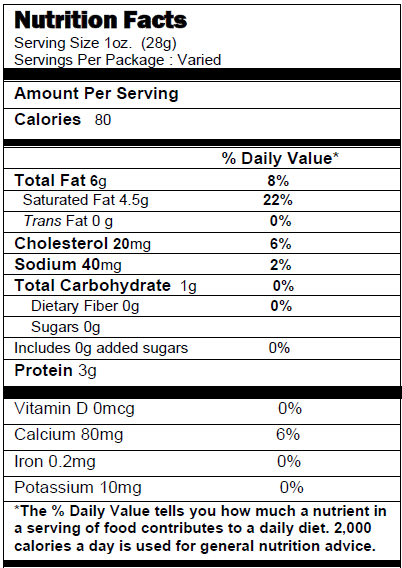
Burrata supplies protein and calcium alongside fat, including saturated fat. Its label matters more than a generic mozzarella entry. For example, Calabro's cow's-milk burrata label lists the following for 1 oz (28 g). These are one manufacturer's figures, not a universal burrata composition. [5]
One label, two amounts
| Nutrient | 28 g | 56 g |
|---|---|---|
| Calories | 80 | 160 |
| Protein | 3 g | 6 g |
| Calcium | 80 mg | 160 mg |
| Total fat | 6 g | 12 g |
| Saturated fat | 4.5 g | 9 g |
| Sodium | 40 mg | 80 mg |
The 56 g column doubles the rounded label values; it is arithmetic, not a second laboratory measurement. A label serving is a reference amount, not an instruction about how much to eat. [6]
“One ball” is not a unit of nutrition unless its weight is known. Cheese shared between several people contributes differently from the same cheese eaten by one person; bread, oil and other accompaniments also contribute to the complete meal.
Original food research
Even one cheese tradition varies.
In a 2020 study of 21 Burrata di Andria samples from seven dairies, researchers blended the inner and outer cheese together for composition testing. The dairy-level mean fat contents ranged from about 16% to 20%, while protein means ranged from about 8% to 12%. [7]
What did the researchers actually measure?
The investigators tested the combined cheese, not just its creamy center. The differences describe particular batches from those dairies, rather than a universal standard. This explains why a cheese name alone cannot supply a precise nutrient calculation.
Keep it fresh
The cold chain comes with the cream.
Keep burrata refrigerated at 40°F (4°C) or below, covered, and follow its package's storage and after-opening instructions. FDA's limit for perishable food at room temperature is two hours, reduced to one hour above 90°F (32°C). A long, warm display is not a useful way to improve the texture. Smell and appearance cannot prove food is safe. [8]
Soft cheeses can support foodborne bacteria, and raw-milk cheese adds risk. CDC recommends pasteurized dairy; people at higher risk of listeriosis should follow its cheese-specific precautions. [9] Burrata contains milk and is not suitable for a milk-free diet.
At a glance
Reference box
- Food identity
- Fresh filled stretched-curd cheese.
- Cookbook connection
- Strawberry Basil Toast w/ Burrata · Peach & Burrata Summer Salad.
- Related topics
- Protein · Calcium · Dietary fat · Sodium · Peach · Basil.
Sources to follow
Revision reviewed October 25, 2026. The original study was read in full; the manufacturer's nutrition panel was inspected directly.
- BelGioioso: Burrata. Structure and ingredients.
- Calabro: Burrata and stracciatella. Product identities and attributed sensory descriptions.
- DEFRA: Burrata di Andria. Protected-name registration.
- Burrata di Andria consortium: How it is made. Cheesemaking sequence, in Italian.
- Calabro: Burrata Nutrition Facts. Product-specific 28 g values.
- FDA: Nutrition Facts.
- Di Cerbo and colleagues, 2020. Original composition and microbiology study; methods and Table 2.
- FDA: Are You Storing Food Safely?. Temperature, time and storage guidance.
- CDC: Soft cheeses and raw milk. Pasteurization and Listeria precautions.